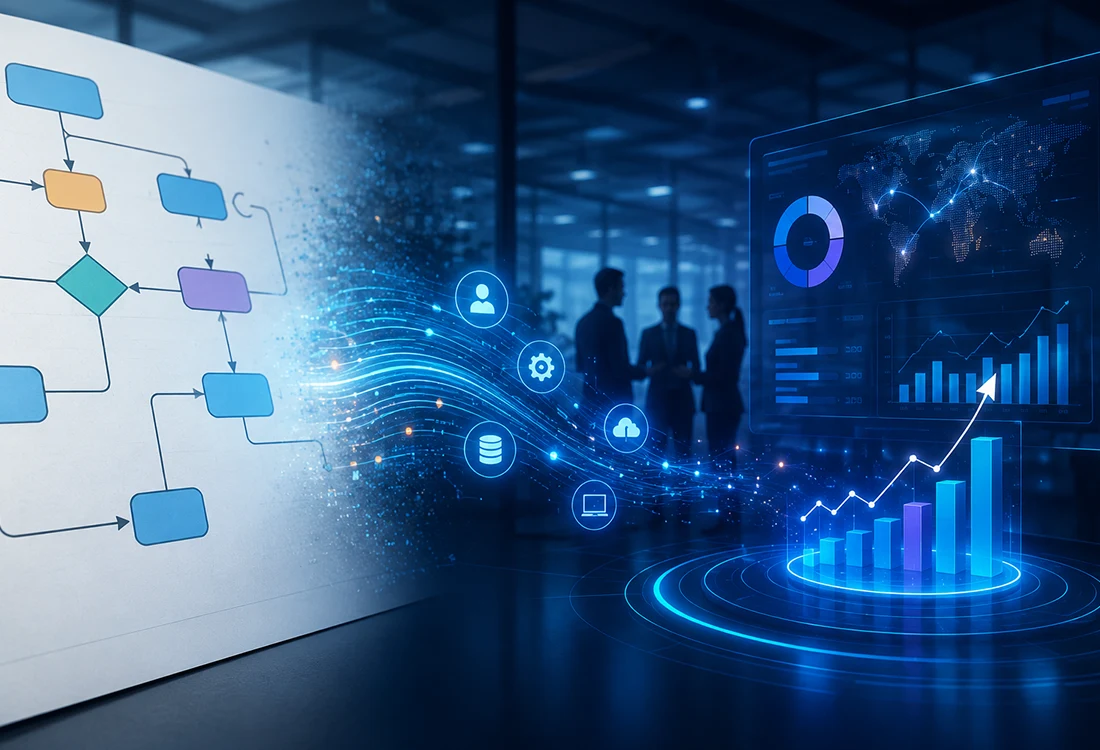

Ask most operations leaders how their core processes work, and they’ll point you to a flowchart. Ask them how those processes actually behave on a Tuesday afternoon when three systems are out of sync and someone’s on leave, and you’ll usually get a shrug. That gap between the documented process and the lived one is bigger than most admit, and it’s expensive.
There’s a name for closing that gap now: process intelligence. It’s becoming one of those capabilities operationally heavy businesses, think banking, insurance, healthcare, retail, manufacturing, can’t really skip if enterprise digital transformation is the actual goal and not just the slide title.
Walk into almost any large enterprise and you’ll find the same pattern across supply chain, order to cash, claims, client onboarding, mortgage operations, trade settlement, fraud investigations, customer service, pick a function. Work hops between systems and teams in ways nobody fully tracks. Data sits in silos that don’t talk to each other. Manual handoffs create rework nobody planned for. Processes evolve constantly, but documentation never keeps up. And when leadership asks where to focus first, there often isn’t a real answer, just guesses dressed up as strategy.
None of this is a rounding error. McKinsey puts revenue drag from inefficient processes at up to 30%, with EBITDA erosion of 15 to 25% from process friction alone. IDC found roughly a quarter of work time gets eaten up by manual effort and friction. Multiply that across a mid sized enterprise and you’re talking real money leaking out somewhere nobody’s watching.
In plain terms, it’s the practice of watching how work really executes across an organization, continuously, instead of relying on a static model of how it’s supposed to work. It pulls in data from systems, applications, people, and events, then turns that raw execution data into something useful: where bottlenecks are, where rework keeps creeping back in, where risk is quietly building, and what to do about it.
That’s a different animal than sitting in a workshop while consultants interview department heads and sketch a flowchart from memory. Process intelligence platforms skip the guesswork. They build a living picture directly from system logs and event data, capturing the process exactly as it ran, variations, exceptions, dead ends and all.
Take a process intelligence platform like RE-ViVE as an example. It connects through secure, read only access to existing enterprise systems and automatically builds a digital twin of how a process is actually running. No modeling sessions. No weeks of workshops. No touching production systems.
A lot of enterprises have already gone down the process mining road and hit a wall with traditional process mining tools. They usually mean manual modeling and coding, often 100 to 300 hours per process to get something usable. What you end up with is an abstracted model with limited attributes, and the second operations shift, you’re rebuilding it. It’s slow, expensive, and covers only a fraction of the business.
Modern process optimization software flips that equation. Setup is closer to plug and play, 2 to 3 hours per process rather than hundreds, and the model captures full context across every event instead of a stripped down abstraction. It updates itself as the process changes, and runs on prem, in the cloud, or as SaaS depending on the business. What used to take six months of consultants can now happen in about 21 days, from total chaos to an interactive digital twin you can actually use.
There’s a fairly simple arc here, even though the tech behind it isn’t.
It starts with visibility: mapping every workflow, step, and dependency, tracking execution in real time and catching outliers and risks as they appear rather than weeks later in a postmortem.
From there, visibility turns into action: surfacing bottlenecks, recommending fixes, giving teams trustworthy data instead of opinions, and in more mature setups, triggering automated responses on its own.
Then comes the part leadership actually cares about: outcomes. Organizations running continuous process observability have reported throughput climbing 15 to 25%, resource utilization improving 10 to 15%, errors dropping 5 to 10%, cycle times shrinking 30 to 50%, and decisions getting made 3 to 5 times faster than before.
Process intelligence isn’t a single department tool. It shows up wherever complex execution quietly costs money.
In banking, that’s loan origination, customer onboarding and KYC, dispute investigation, payment exceptions, fraud detection, credit risk, regulatory reporting, collections, the kind of process mining finance teams now lean on for evidence instead of hunches. In retail and FMCG, it’s inventory replenishment, supplier procurement, returns, promotions, warehouse management. In oil and gas, maintenance orders, hydrocarbon production allocation, HSE compliance, field operations. Process mining supply chain work follows the same logic, alongside order to cash, procurement to pay, risk and compliance, customer service, HR, IT operations.
A few real numbers make this less abstract. A B2B parts distributor on Oracle EBS had its order to delivery process analyzed across 41 million plus transactions. Average time was 8.4 days, but the slowest quartile dragged to 19.8 days, more than double the best flows. About a quarter of orders drove most of the delay, and the cause wasn’t volume, it was how those orders were executed.
A global FMCG company on SAP S/4HANA Cloud told a similar story. Across 120 million plus transactions and over 100 plants, average order to invoice time was 5.6 days, but the slowest segment took 12.9 days, nearly 7 times slower than the best flows.
A global bank running customer onboarding through ServiceNow analyzed over 953,000 service requests. Average cycle time sat at 16.62 days, with documentation rework hitting 40% of cases. Targeted fixes pointed to savings that would cut processing time to around 9 days, roughly a 25% improvement.
There’s a newer layer showing up on top of process data now, sometimes described as ai driven process mining or, more loosely, a process intelligence copilot. The idea is simple: ask a question in plain English, like where are we losing the most time in onboarding, and get back an answer grounded in real, verified execution data instead of a vague summary. The better versions run on a deterministic core tied to actual numbers, work with whatever large language model an organization prefers, can be trained on internal SOPs and regulations, and eventually support agents that take safe, automated actions with full process context behind them.
One thing worth knowing: this doesn’t require months of disruption. Most engagements start with a single process, order to cash, onboarding, claims, supply chain, ticket resolution, whatever’s hurting most. The organization grants read only access to existing data and logs. No modeling sessions, no long workshops, no touching live operations. The platform stitches together execution data across systems and handoffs on its own.
What you walk away with is a real end to end view of how the process runs, not how someone assumes it runs, clear visibility into delays and rework and cost drivers, evidence backed answers for why outcomes happen, and a foundation to prioritize what comes next, whether that’s process fixes, automation, or AI driven decisions.
Hidden process complexity doesn’t disappear just because nobody’s looking at it. It keeps draining revenue, slowing teams down, and building compliance risk that only becomes visible once something breaks. Process intelligence gives organizations a way to stop guessing and start watching execution as it really happens, then turn that into measurable gains in speed, cost, and accuracy. For companies still leaning on outdated process mapping exercises or one time process mining snapshots, moving toward continuous, automated process intelligence is starting to look less like a nice to have and more like the baseline for real process transformation.
What is process intelligence in simple terms? It’s the use of real execution data, pulled from enterprise systems, applications, and event logs, to continuously observe how a process runs rather than how it’s assumed to run on paper.
How is it different from process mining? Traditional process mining relies on manual modeling, limited data attributes, and static snapshots that need rebuilding whenever operations change. Process intelligence automates that with continuously updating visibility built from live execution data, in a fraction of the time.
How long does implementation take? Modern platforms can deliver a working view of a process in about 21 days, versus the months manual, consulting led process mapping projects typically need.
Does this require access to sensitive systems? Most platforms only need secure, read only access to existing data and logs. Nothing gets modified, and operations aren’t disrupted.
Which industries get the most value? Banking, insurance, healthcare, pharma, telecom, retail, manufacturing, and oil and gas see the biggest wins, especially in onboarding, claims, order to cash, procurement, and compliance reporting.
Can it help with compliance risk? Yes, this is one of the stronger use cases. It keeps a complete, drillable record of how a process executed, including every variation, supporting compliance process optimization, audit readiness, and faster root cause investigation when something goes wrong.