


Every manufacturer has two factories. The first is the one drawn in SOPs, ERP configurations, and value-stream maps — clean, linear, predictable. The second is the one that actually runs every day: orders rerouted around a missing raw material, a quality hold that loops a batch back three steps, a maintenance work order that waits two days for an approval nobody remembers configuring. The gap between those two factories is where margin quietly disappears.
Process mining gave manufacturers their first honest look at that second factory. Process observability — its continuous, always-on successor — is what finally makes the picture actionable. Here’s why the combination matters, and what the numbers say.
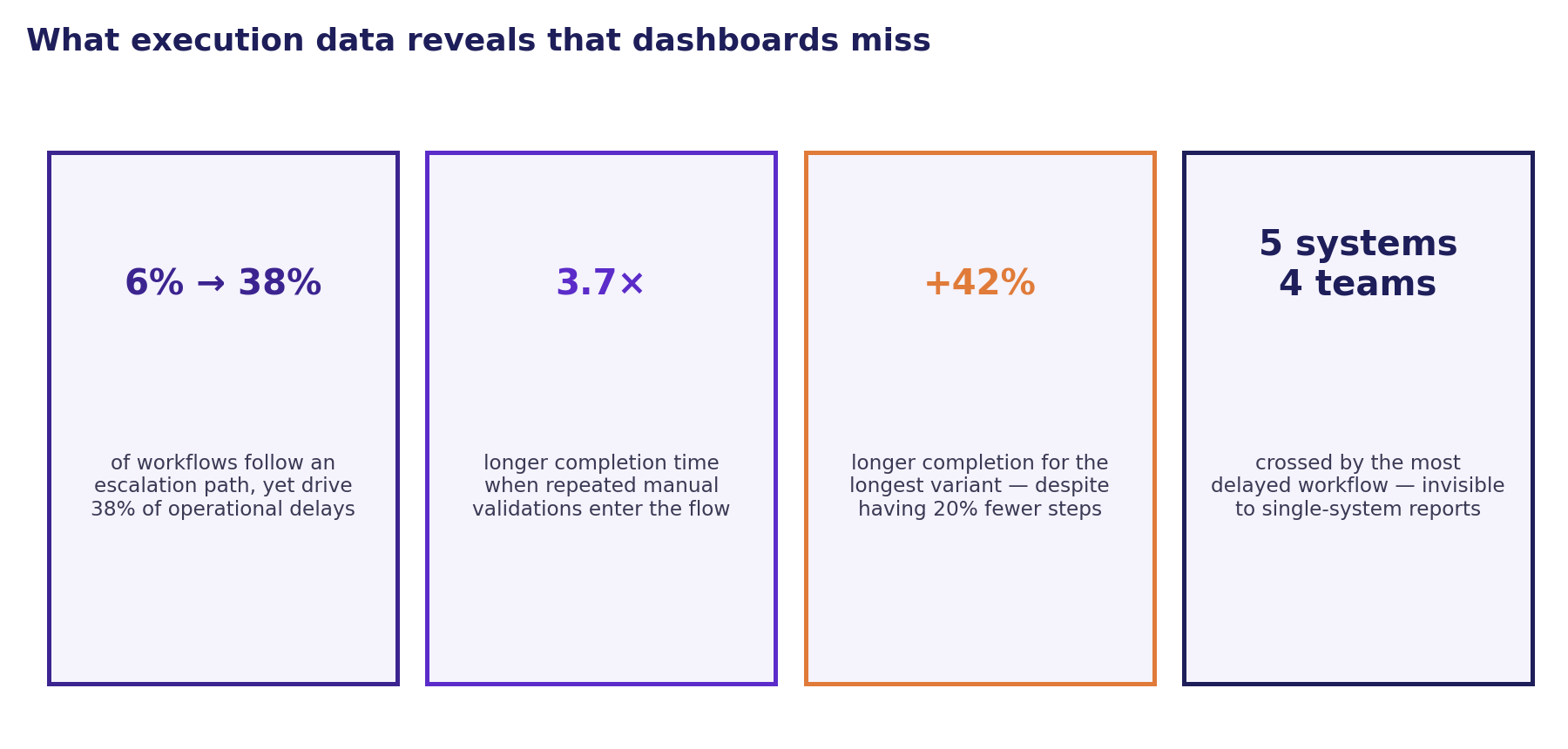
Manufacturing execution rarely lives in one system. A single customer order can touch the ERP, the MES, the warehouse system, quality management, transport planning, and a handful of spreadsheets before it ships. Each system reports its own slice faithfully — and none of them shows the end-to-end reality. Plants see fragmented signals, not execution truth.
The financial consequence is bigger than most leadership teams assume: operational inefficiencies — rework, delays, fragmentation, and execution drift — can consume 15–25% of EBITDA. That leakage doesn’t show up as a line item. It shows up as excess cycle time on the order book, overtime to hit shipment dates, duplicate effort between planning and the floor, and quality escapes discovered too late. Dashboards don’t catch this because dashboards report outcomes (on-time delivery: 92%) while the damage happens in execution: the variants, handoffs, loops, and exceptions between the numbers.
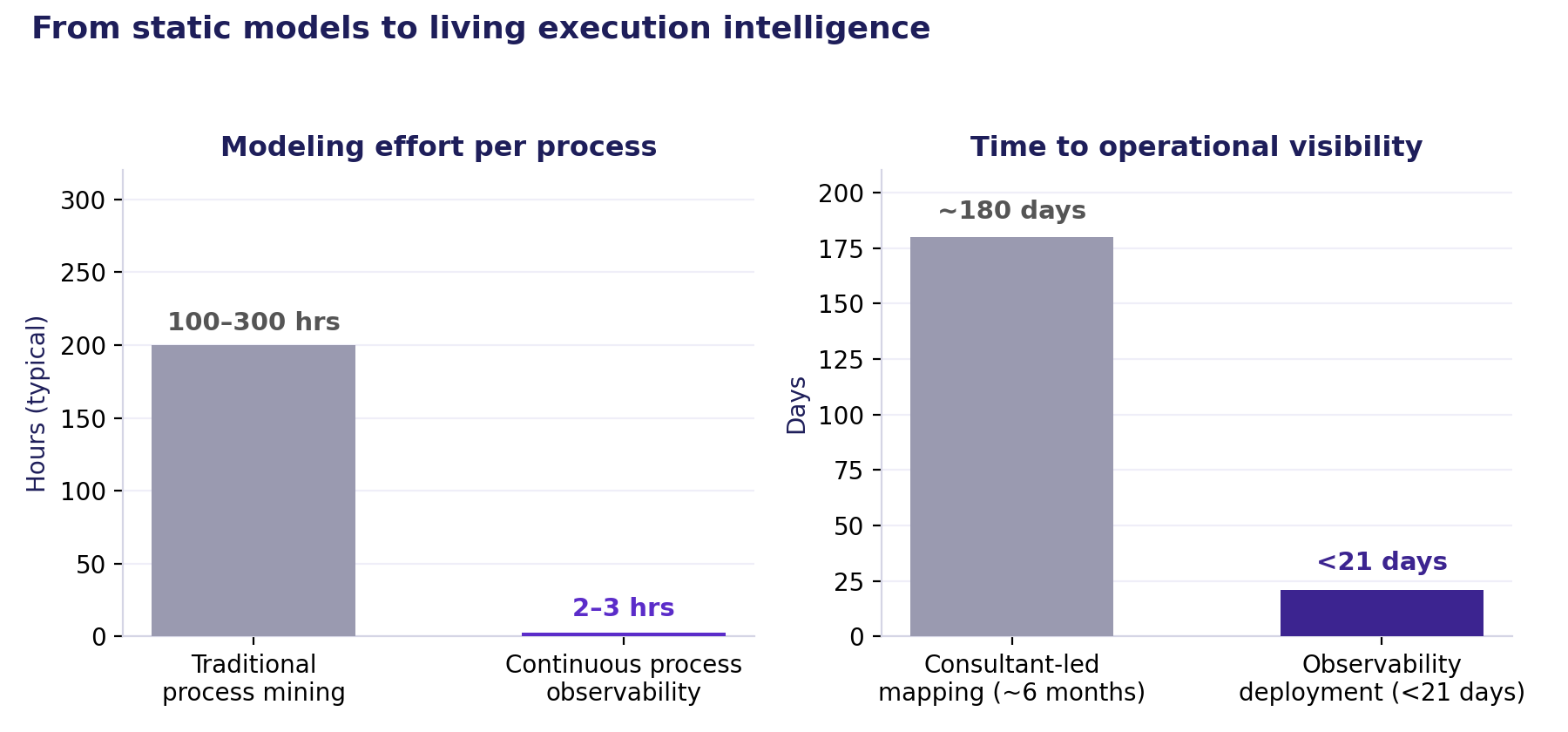
Classic process mining reconstructs how a process ran from historical event logs. It’s powerful, but the traditional approach has real friction: manual modelling and data preparation that can take 100–300 hours per process, models built on abstractions with limited attributes, and — critically — models that go stale the moment operations change. In a manufacturing environment where product mix, suppliers, and shift patterns shift constantly, a six-month consulting-led mapping exercise describes a plant that no longer exists by the time the report lands.
Process observability changes the operating model. Instead of a retrospective snapshot, it maintains a living digital twin of execution — automatically stitched together across ERP, MES, WMS, quality, and maintenance systems through read-only connections, updating as the plant runs. Modern platforms bring a process online in 2–3 hours of setup effort instead of hundreds, and deliver full operational visibility in under 21 days rather than two quarters.
1. Production scheduling and planning.
Observability exposes where planned sequences diverge from executed ones — which changeovers actually happen versus which were scheduled, and which order types consistently trigger replanning loops. That’s the raw material for fixing schedule adherence rather than arguing about it.
2. Equipment maintenance and work-order management.
Maintenance work orders are a classic hidden-delay factory: approvals, parts availability checks, and technician reassignments create waiting time that never appears on the CMMS dashboard. Execution-level visibility shows exactly where work orders stall — and surfaces production asset utilization and idle time that standard OEE reporting averages away.
3. Quality control and inspection.
Rework loops are among the most expensive variants in any process map. Observability quantifies them: which products, lines, shifts, or suppliers generate the loops, and what each loop costs in cycle time. Continuous outlier detection flags deviations as they emerge instead of at the monthly quality review.
4. Inventory and raw-material management.
When the flow from procurement to line-side delivery is observed end to end, expediting patterns, repeated availability checks, and manual intervention hotspots become visible — the behaviours behind both stockouts and excess buffer stock.
5. Order fulfilment (order-to-cash).
From order intake through credit review, fulfilment, invoicing, and collections, a signal layer over the executing process catches SLA drift, fulfilment risk, invoice exceptions, and reconciliation gaps while there’s still time to act — not in next month’s DSO report.
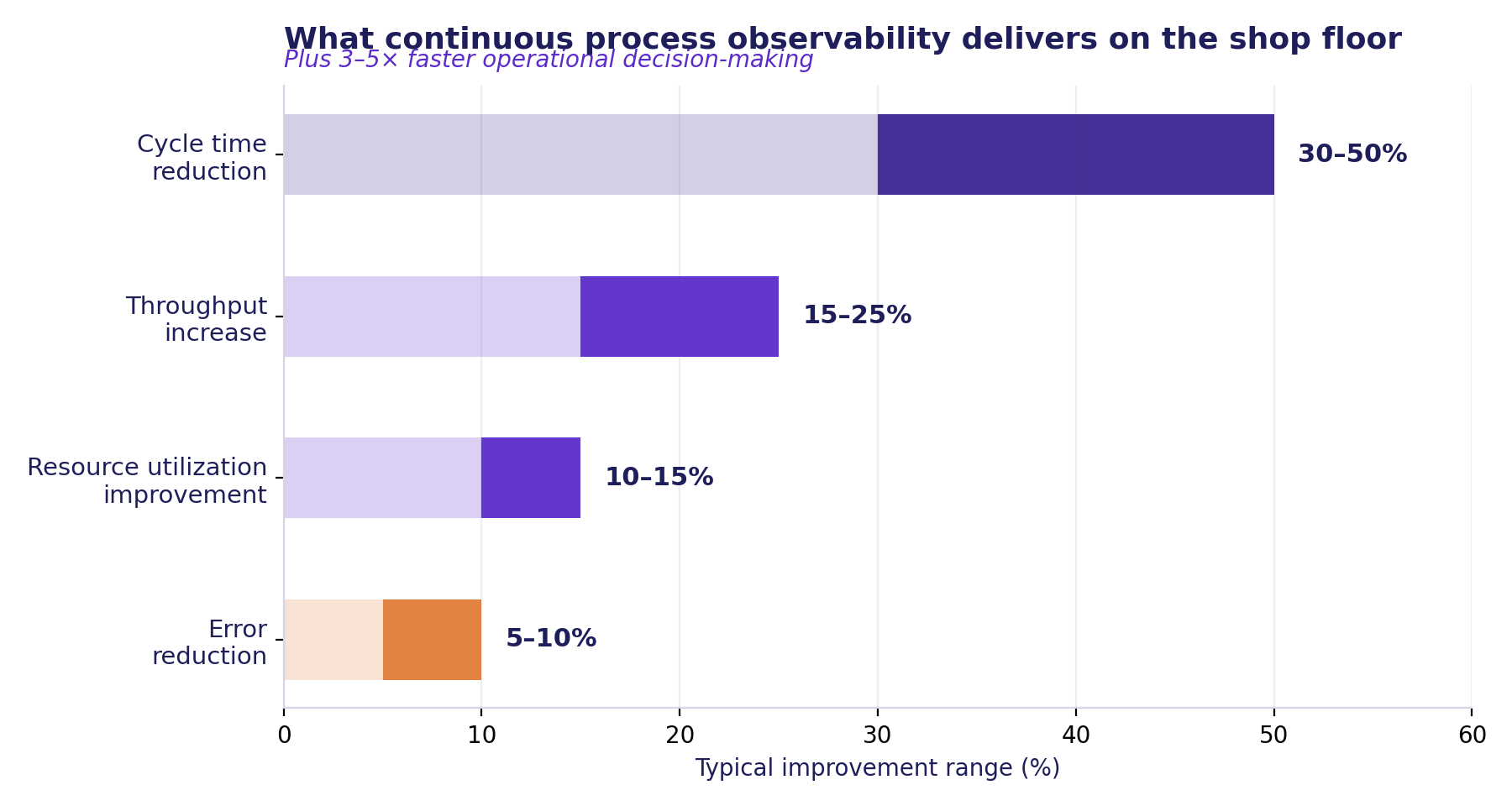
Cycle time: 30–50% reduction — mostly by eliminating waiting, rework loops, and unnecessary handoffs rather than speeding up the work itself.
Throughput: 15–25% increase — the same assets and people, minus the friction.
Resource utilization: 10–15% improvement — including recovery of idle capacity that was invisible in aggregate reporting.
Errors: 5–10% reduction — driven by catching exception-prone paths early.
Decision agility: 3–5× faster — because arguments about “what’s actually happening” get replaced by evidence.
For a mid-sized plant, even the conservative end of these ranges typically outweighs the cost of the visibility layer many times over — especially when the alternative is inefficiency silently consuming a double-digit share of EBITDA.
Most manufacturers are now under pressure to “apply AI” to operations. Here’s the uncomfortable truth: AI initiatives built on transaction data alone see order statuses and KPIs — they don’t see the variants, handoffs, delays, and rework loops where the real problems live. An AI agent scheduling production against a process model that doesn’t reflect execution reality will optimize the factory that exists on paper, not the one on the floor.
Process observability is therefore not just an improvement tool; it’s the operational readiness layer for enterprise AI — supplying the workflow understanding, exception paths, cycle-time baselines, and continuous monitoring that any serious automation or agentic initiative requires. Get the execution visibility first, and the AI investment stops being a leap of faith.
The practical playbook is deliberately unheroic:
Then prioritize by evidence: fix the 6% of paths causing 38% of the delay before touching anything else.
Manufacturers have spent decades perfecting the physical flow of material. The next wave of competitiveness comes from perfecting the flow of work and that starts with the ability to see it.
Stop mapping workflows. Start observing execution.