
BANKING WORKFLOWS

Different workflows.Different questions.One need: see how thework actually executes.

RE-ViVE can begin with any banking workflow that crosses systems, teams, controls or automation.It reconstructs how that work actually executes end to end.
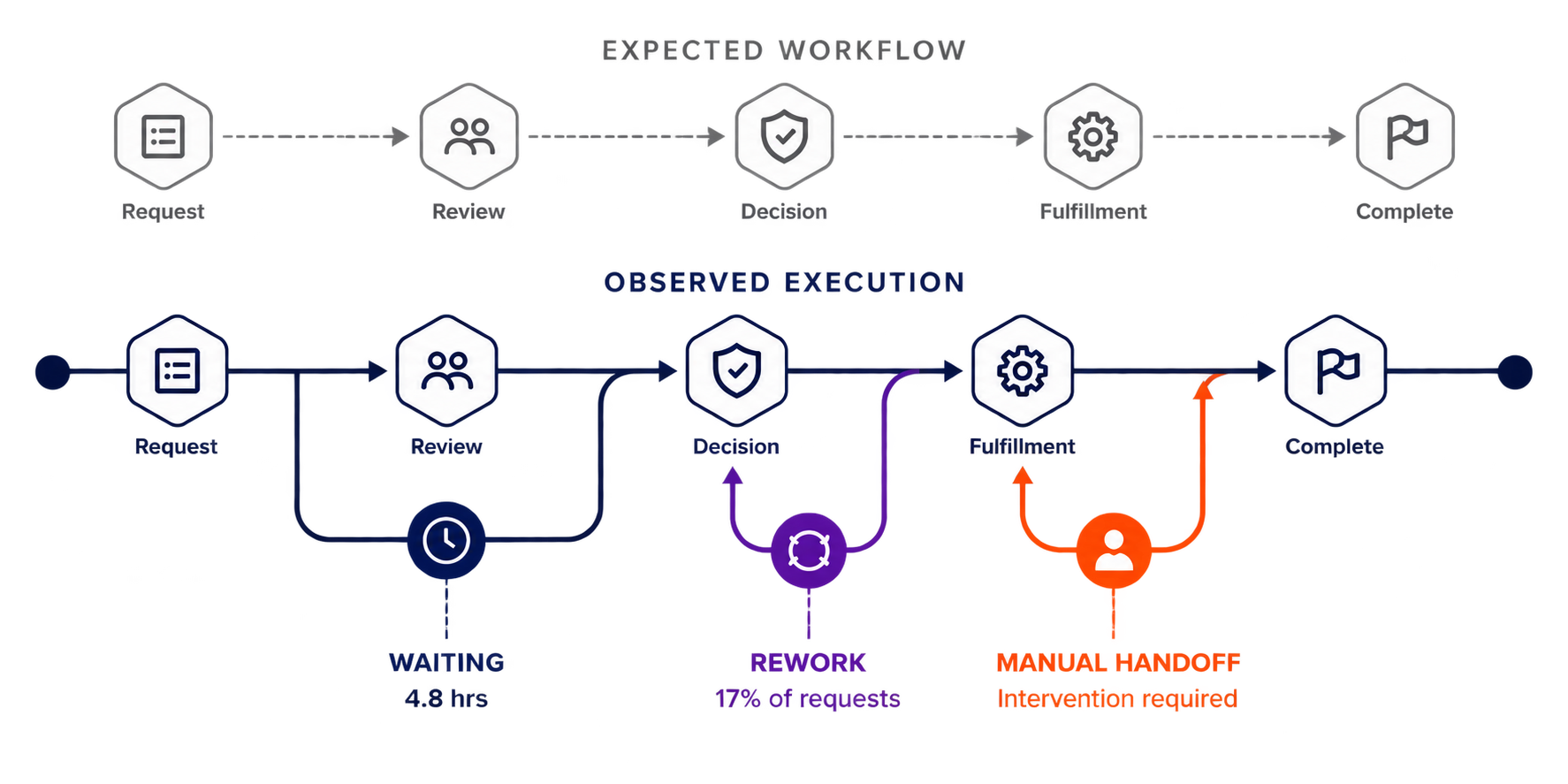
Expected workflow compared with observed execution, revealing waiting, rework and manual intervention
BANKING WORKFLOW LANDSCAPE

Execution Intelligence across high-impact banking workflows.

Banking workflows differ, but the execution questions are remarkably similar. These are representative examples—not a fixed workflow library.

Customer & Client Onboarding

Examples: KYC/KYB · Documentation · Approvals · Account Setup
Payments & Treasury Operations

Examples: Payment Processing · Exceptions · Investigations · Repair

$

Lending & Credit Operations

Examples: Application · Underwriting · Approvals · Closing

Operations & Service

Examples: Service Requests · Case Management · Exceptions · Escalations

Risk & Compliance Operations

Examples: KYC/AML Reviews · Investigations · Approvals · Remediation

Trade & Securities Operations

Examples: Trade Processing · Exceptions · Settlement · Reconciliation

WHERE TO START

Start where the workflow is hardest to explain.

The best candidates are not always the largest processes. They are the ones where important execution is difficult to see end to end.
1
Crosses multiple systemsNo single application contains the full path.
2
Moves across teams or ownership boundariesResponsibility shifts as work progresses.
3
Cycle time or outcomes vary significantlySimilar requests can finish very differently.
4
Exceptions, rework or intervention are commonThe intended path is not the only path.
5
No one has the complete end-to-end viewTeams know their part, but not the whole execution story.

What makes a workflow hard to understand → what RE-ViVE makes visible

Cross-system execution
Variable cycle time
Repeated activity
Different routes
Reviews & exceptions
End-to-end path
Waiting & bottlenecks
Rework & backflow
Variants
Control / exception paths
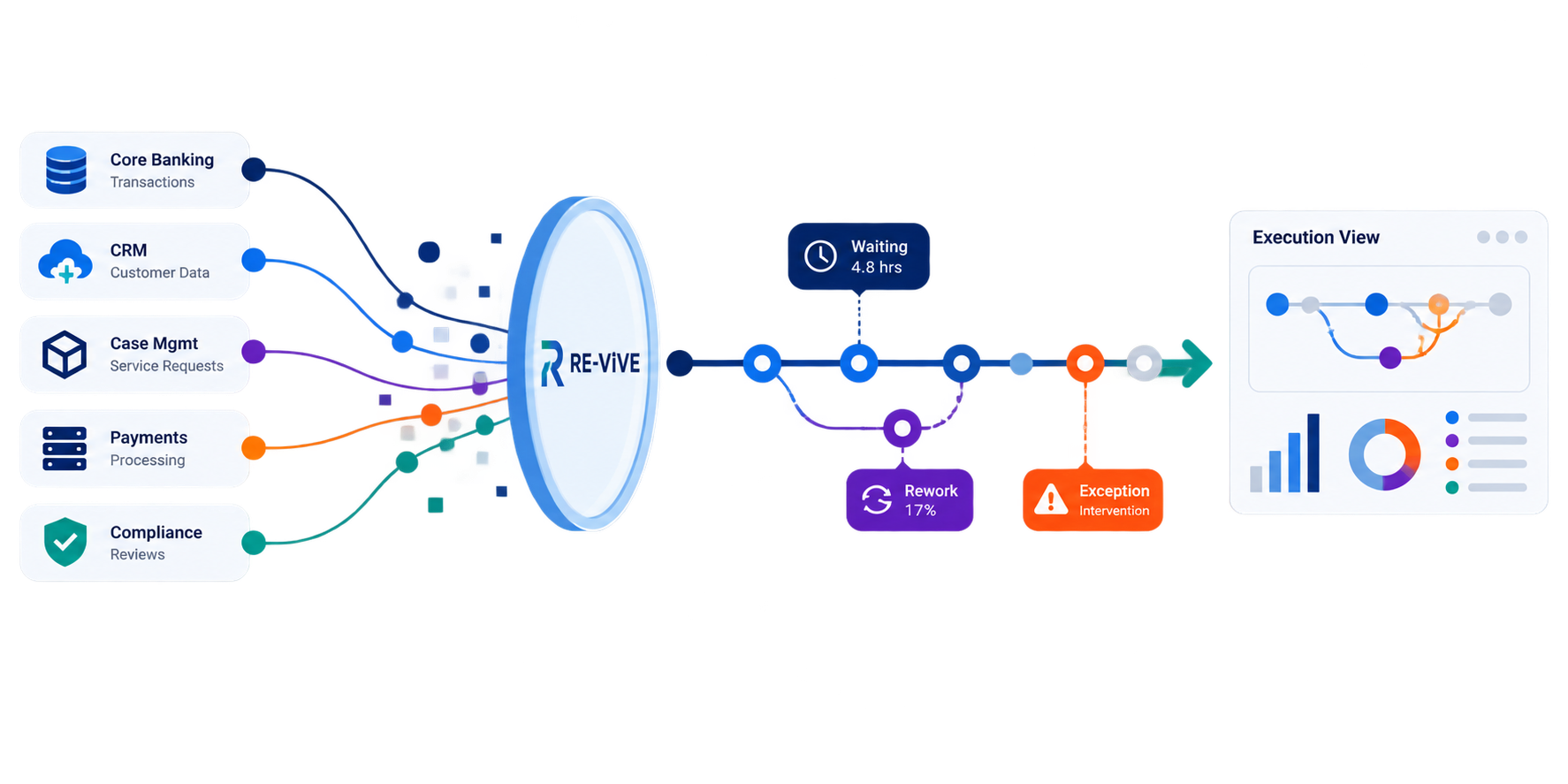
Execution evidence from banking systems being organized by RE-ViVE into a current execution view
You do not need to know the workflow perfectly before starting. RE-ViVE automatically reconstructs the current state from the execution evidence already being created.
ONE PROCESS. DIFFERENT QUESTIONS.

One execution reality. Different stakeholder lenses.

Commercial customer onboarding is one example. The underlying execution is the same; the questions change depending on who is looking.

Multiple analytical lenses examining different aspects of the same execution path
OPERATIONS

Where is cycle time accumulating?

RISK

Which paths enter additional review?

TECHNOLOGY

Where does execution cross systems?

TRANSFORMATION

Did automation actually reduce manual work?

BUSINESS

Which customers experience the longest or most complex path?

The value is not another process diagram. It is one execution foundation that Operations, Risk, Technology, Transformation and Business teams can examine from their own perspective.
REAL BANKING PROOF

Nearly 100 service workflows. No process-modeling exercise first.

The value of Execution Intelligence becomes clearest when the bank does not already have a clean, documented process model to work from.

BUSINESS OBJECTIVEReduce SLA exposure with a current, near-real-time view of how service workflows actually execute.See where time accumulates, which paths require intervention, and how workflow behavior changes as customer needs, regulations and operations evolve.
THE OPERATING LANDSCAPE BEFORE RE-ViVE

The problem was not a lack of data. It was a lack of usable execution context.

The bank needed to understand nearly 100 service workflows and reduce SLA exposure, but the execution evidence was fragmented across Excel files, workflow platforms and custom applications.

1,800+ distinct activitiesSystems logged thousands of activity types, but documentation did not reliably identify which activities belonged to which workflow.
Workflow knowledge kept changingAd-hoc customer needs, regulatory requirements and operating changes altered execution month to month.
No clean blueprint to start fromTeams understood parts of the work, but no current end-to-end model existed for nearly 100 workflows.
Near-real-time visibility matteredThe bank wanted to understand what had happened within a roughly four-hour operational window, not only through retrospective analysis.
WHAT RE-ViVE MADE POSSIBLE
DISCOVERY

~4 hours of SME time

Enough to establish source context and business meaning—without documenting every workflow first.

RECONSTRUCTION

Nearly 100 workflow views

Execution evidence was organized into observed runtime paths across multiple operating environments.

FIRST VALUE

~10 business days

The bank could begin seeing execution, SLA behavior, variants and intervention patterns quickly.

The important result was not simply a set of process maps. The bank gained a current execution view that could keep reflecting new transactions and changing workflow behavior—without requiring the workflow knowledge base to be perfectly maintained first.
START WITH THE WORKFLOW YOU MOST NEED TO UNDERSTAND

You do not need to redesign it, document every variant or move it into one system first.

Start with the execution evidence already being created by the systems, teams and controls involved in the work.

No manual data collationUse required execution evidence from existing sources.
Read-only accessNo production write access or workflow disruption.
Flexible deploymentOn-prem, client cloud, private cloud or SaaS.
First view quicklyTarget a first usable execution view in about 10 business days.